
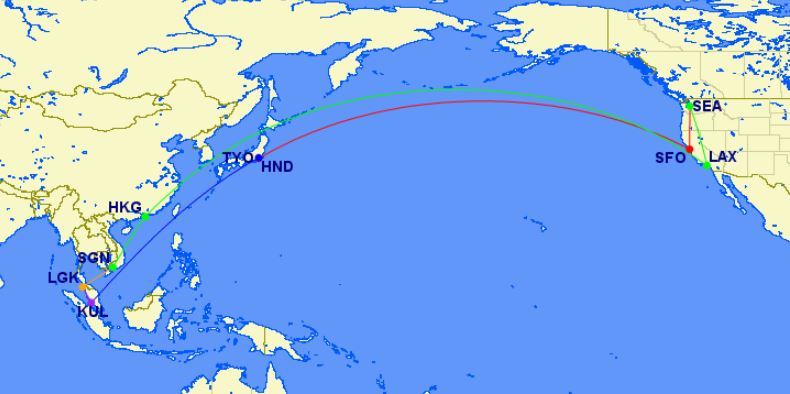
This November, Jenine and I will embark on our second multi-country vacation. Planning for this type of vacation (for me) begins about a year in advance. I’m always thinking about where I want to go next and how I’ll get there. Someday, I may get to all of those places but it all starts with planning.
Source: GCMap
Where to Go?
This seems really obvious but I want to maximize the use of my miles and points. I look for the sweet spots in my airlines partner award charts and I consider aircraft types and airlines I haven’t experienced, as well as where they fly. Yes, I’m odd – I choose the airline first and then figure out where they go.
For Alaska Airlines Mileage Plan, they partner with several Asian carriers and I hadn’t previously flown JAL so I wanted to fly them to get to some destination. That’s quite literally how I started. I looked at the JAL route map to see how far I could go and if that destination was of interest to me.
When to Go?
There are two (or three) major factors to consider when deciding what time of year you will travel to your destination: Weather, Tourist Season, and Festivals or Events.
Weather
- In northern or southern climates, four seasons generally exist. A destination can be completely different based on the season. New Zealand in winter vs summer or Iceland in winter vs summer are very different destinations. The further from the equator will affect daylight hours (a lot in the summer or very few in the winter)
- Destinations closer to the equator generally only have dry and wet seasons. If you like pain, the wet season is the way to go. Otherwise, try to go during dry season or during shoulder season. Be aware that the east and west coasts of a country can have different wet and dry seasons
Tourist Season
- Tourist season at a destination can really affect how may activities you can do and how crowded the sights are. Tourist season is generally most influenced by the weather but major holidays can also have an effect.
- During low season, accommodations can be as much as 40% less than high season (and with greater opportunity for upgrades)
- Shoulder season (the time between low and high seasons) can really be an optimal time because the weather is usually pretty good and the crowds haven’t yet grown
Festivals and Events
- Festivals (like Oktoberfest) draw large crowds and can make finding accommodations difficult
- Your best bet to attend festivals and events is to book accommodations as early as possible or be prepared to pay higher prices or have further to drive
Hotel or Air – What to book first?
When using miles and points to book a major journey, the first question is usually, D’o I book my hotel first or air travel first?” Generally, the answer is air travel, but it depends.
Air travel is usually the biggest key for me because I want to fly business or first class if I can and those seats aren’t always easy to find. Sometimes, the seats are there but the dates aren’t. Or, sometimes there is only one seat in business and the other in economy. Additionally, some airline routes aren’t flown daily so you may be limited to certain days of the week in which to search.
I generally book hotels second as they are much easier to get on points and there is almost always a cash option. If there was an aspirational property at a really good points price, I might speculatively book the hotel and then see if I can get airfare. For example, with Marriott’s takeover of Starwood, there are some extremely good points redemptions from the SPG portfolio available to book until the end of the year.
When to Start Planning?
For Alaska Airlines, I know that most partner awards are bookable about 330 days out. My planning has to start before then so I can be prepared at the time the award chart opens. I begin by looking at current availability (if I book 330 days from today, is there space available?). I do this for several days to see if there is consistent award space when the booking window opens. I tend to do research to see what time of day the award booking window opens as well (for example, it may open at midnight in the timezone of the airline I am searching).
Booking the Airline
Alaska Airlines, like most airlines, don’t actually show you all of their partners when searching for space so I have to search on the right website to find the availability. I knew that I would fly both JAL and Cathay Pacific, both OneWorld airlines. Generally, British Airlines’ or Qantas’ website is a good place to start with OneWorld airlines, so I began checking the British Airways site. My concern was only booking the long leg of my trip, in this case, San Francisco or LAX to Tokyo. Once I found business class seats on either of those routes (to either Tokyo airport), I went to Alaska Airlines’ website and booked that leg. Since I was already booking that leg, I did add my positioning flight (Seattle to San Francisco in my case) but if SEA-SFO wasn’t available, I would have just booked the SFO-HND flight.
Now I had a flight to Japan but my destination was Malaysia. I wanted to spend about 3 days in Tokyo before heading onward to Malaysia so I waited 3 days and then searched (again on British Airway’s’ website) for a Tokyo to Kuala Lumpur flight. I didn’t care which Tokyo airport we departed from. When I was able to identify there were 2 business class seats on that route, I called up Alaska Airlines and spoke to the partner desk. I gave them my PNR, or record locator, they found my flights, and then I gave them the specific flights that I wanted to add. They were able to see the award space and added it on.
The rest of the air travel worked in similar fashion. Sometimes, either because of lack of space or poor value for miles, you’ll want to consider paying for flights. Asia and Europe have many low cost carriers so intra-country and short international flights make more sense to book via cash.
Documentation to Travel
Once your countries have been identified, you’ll want to confirm your need for a Visa (on arrival or obtained before travel). There are many good sites with Visa information but I always start with the US State Department where you can search for Visa requirements for each country. For Japan for example, the US State Department website shows the following:
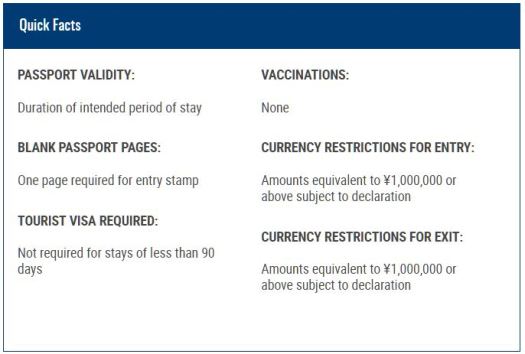
Always ensure that you have the correct number of days remaining in your passport, the correct number of pages, visa requirement, and vaccination requirements. A few notes about each.
Passport Validity and Blank Pages
Some countries require a passport be valid only during the stay whereas other can require 6 months or more validity (the date upon which the passport expires)
Most countries require that there be a minimum of one page available
Visa
The majority of countries require a visa
While on vacation, a tourist visa is sufficient but if working, a work visa may also be required
For US citizens, some countries will provide a visa on arrival (and may or may not charge a fee). Other countries require a physical or e-visa be obtained prior to travel. All visas have an expiration date
Vaccinations
Some countries mandate that a full or partial vaccination record be presented upon entry to that country. It is always best to cross reference the US State Department website with that country’s US consulate website
Some countries require vaccination records (like Yellow Fever) if traveling from a Yellow Fever country
A travel medicine appointment is recommended 1 to 3 months prior to out of country travel to validate you have the required suggested vaccinations. See the CDC website for a list of country specific vaccine recommendations
While not a vaccination, it is a good idea to carry antibiotics for traveler’s diarrhea
Mapping Your Location
I have to have a general sense of what I want to do when I arrive at a destination. For me, this involves a lot of web searches and ultimately coming up with a must-do list and a like-to-do list. Once I’ve got those lists, I map them on Google My Maps. Seeing where everything is, in relation to other places, really helps me plan my days, clustering those sights that are close together. For example, here is one of my planned maps for Tokyo. I won’t get to all of those sights, but I’ve identified what can be done in one day. Should I need to make changes, I can access the map on my phone and make adjustments on the fly.
Register with the STEP Program
STEP, or Smart Traveler Enrollment Program is a service of the US State department which allows you to register your travel with the US government. Once registered, you will get regular updates from the State Department on anything that would affect you as a US citizen or general updates from the region. Currently, I’m getting notifications of how to vote while overseas. I’ve also had notifications of typhoons, earthquakes, volcano eruptions, and general unrest in a destination. You will also receive any state department travel warnings.
The STEP site allows you to enter the addresses of where you will be staying, your contact information, your travel companions, and your emergency contact. The site also show you any current travel advisories. In the event of an actual emergency, the US government will know where to look for you and be able to contact you (potentially) and your emergency contact. You can enroll in STEP here.
Copying Your Travel Documents
Many countries require you to keep your passport on your person while traveling which presents the opportunity to lose your passport, or have it stolen. I always copy (or take a picture of) my travel documents and email them to myself. This ensures that my information is in the cloud, should I need to access it. I also always copy my passport and keep it in the hotel safe.
Prepare to be a Gracious Guest in Your Destination Country
If the country I am traveling to doesn’t use English as a common language, I want to learn basic phrases or words: excuse me, please, thank you, toilet, do you speak English, etc. A quick Google search will get you started. Locals respond so much better when they know you are trying. You can always use Google Translate, which can be hit or miss, if you don’t know a word. Google Translate is also adequate in reading words as well.
I also want to learn basic customs and norms such as
- Which side of the road to they walk/drive?
- Is it ok to eat or drink while walking in public?
- Can I hold hands with my partner?
- Are there certain clothing restrictions I should be aware of?
- Are there religious rules I should be aware of?
- Is tipping acceptable? To whom?
- Are there head/hand gestures that I should be aware of?
I also want to know what scams to be aware of. Scams are a real part of any culture and I want to ensure I am as safe as I can be. There is an older infographic which I’ve found helpful over the years found here. Business Insider had a fairly recent article which highlights some of the more common scams.
Know which Medications are Allowed
When traveling, we can take for granted the medications that we can get, either over the counter or via prescription. Each country has different laws regarding the medications you can bring into a country or buy. I always start by checking the the website of the country’s consulate in the United States.
The United Arab Emirates now requires all visitors to register prescription and over the counter medications before entering the country. Many countries prohibit over the counter medications such as pseudoephedrine. In Japan, Vicks inhalers and Adderall is strictly prohibited. Singapore has an extensive list of prohibited medications (including chewing gum). The penalty for bringing illegal medication into the country can be death. I always check my medications against the prohibited medication lists of the countries I am traveling to.
Lastly, know the names of common medications you might use. Aspirin isn’t always called aspirin. Wikipedia lists 130 common names in the world for Ibuprofen. Acetaminophen (Tylenol) is more commonly known as Paracetamol (or panadol or APAP) in the rest of the world.
Know How to Get Money
In the US, spending money is pretty easy – most places accept cash, credit cards, digital payments, or even checks. Abroad, the same can’t always be said. Learn about the currency of the country to which you are traveling and how to get some money.
Usually the best strategy is to use your debit card to withdraw money at an airport ATM when you arrive (not to use the airport money exchange). It’s best to use a debit card which doesn’t incur transaction fees (such as the Schwab debit card). Be sure you know your daily withdrawal limit so you don’t run out of money.
There are times when you may have to exchange physical cash for local currency. Most countries require new, crisp US bills before they will consider exchanging. In some countries, you can only exchange US $100 whereas others will only accept $50 or $20 bills.
When using a credit card, make sure you are using one that does not have a foreign exchange fee. Always select local currency when paying by credit card as you’ll get the best exchange rate. Many merchants will try to convince you to pay in your own currency so they can charge you a fee (Dynamic Currency Conversion or DCC) in which you’ll get ripped off by a couple percent (which can really add up).
Lastly, credit cards aren’t universally accepted. In major cities, credit cards will likely be accepted at major hotels but even restaurants may not accept them. Research your destination before you go so you don’t get stuck with a bill you can’t pay.
Learn Customs Regulations for Each Country
Every country has different requirements for what you can bring in and take out of the country. Knowing what you can and can’t take will make your travel experience much better. I can imagine getting items confiscated by Customs, or worse, getting fined (or arrested) for false declaration, can make the beginning of a trip a real bummer.
Most countries restrict weapons, drugs, and money. The first two are somewhat obvious but some countries will only allow you to bring as little as $1000 US dollars into a country. Exceeding that limit may result in confiscation. There are some weird restrictions which most people will never need to know about but it’s always good to know. In Japan, you can’t bring more than 24 tubes of lipstick. Chewing gum is illegal in Singapore. Kinder Eggs are banned in the United States (we have special [read lame] Kinder Joy eggs here). Toothpaste is banned in Algeria. It’s a weird world out there sometimes.
Electronics
Begin to think about what electronics you will need. Remember that for international travel, even carry on baggage may have weight limits. Don’t forget power banks and cords for all of your devices. Most importantly, don’t forget to take a power adapter. This BESTEK Universal Travel Adapter is a good option because it has USB ports, multiple plug types for multicountry travel, a short extension cord, and multiple outlets.
Consider signing up for a VPN if you don’t have one. The internet is widely available in the United States but is restricted in much of the world. You may not need a VPN in Europe but if you’re traveling to Asia, Africa, or South America, I would highly recommend one. Enabling a VPN on your phone or laptop can allow you to access prohibited content, such as Facebook, Google, and more. When I was in China, I used Express VPN and it worked well because I could choose a non-Chinese site to ping (fooling the Great Firewall of China).
Souvenirs
Some countries have great bargains, or great values, on certain souvenir items. It’s always best to research what is good to buy in the country you are visiting. Electronics in Japan can be fantastic. Gold in Dubai can be a great bargain if you are ready to haggle and understand the current price of gold. Textiles in China, Japan, Vietnam, and India can be a fantastic value. It’s always best to do a little research and be prepared.
Most importantly, when planning a big trip, don’t let it overwhelm you. Travel is supposed to be fun. Being prepared makes it easier but shouldn’t be a major stressor. Safe travels.
 The Travels & Tips of Nurse Traveler