
Over the weekend, I went on my first mileage run of the year. I was posting about it on Facebook and as a Facebook story and I received several questions about what it is and why I do it. While responding on Facebook would have been fine, it isn’t really the easiest to explain in a response.
What is it?
At its most basic level, a mileage run is just flying from A to B back to A in a single day or over a couple days to gain EQM, or Elite Qualifying Miles. Airlines have different criteria for attaining different status levels and most include some requirement of a minimum number of miles flown (BIS or Butt In Seat miles) or segments. Unless you live near a secondary airport (an airport where you almost always have to connect to make your destination), miles will almost always the metric for status. There certainly are more complicate mileage runs, and frankly, those are almost always more fun.
Alaska Airlines is my carrier. For the past 3 or 4 years, I’ve had top tier status, which is MVP Gold 75k. This is attained by flying Alaska metal (actual Alaska Airlines airplanes) 75,000 miles in a calendar year or flying 90 segments in a calendar year. MVP Gold 75k can also be attained by flying Alaska and partner airlines 90,000 miles annually.
Why?
Last year (2018), I wasn’t close to 75k due to my flying patterns. I flew fewer mileage runs and my work travel was very limited for the first 6 months of the year for varying reasons. This year, I know my travel pattern will be different so I want to ensure I’ll attain 75k without having to worry about booking a mileage run at the end of the year.
For me, there are a lot of advantages to being 75k. The value of status will vary from person to person. As a 75k on Alaska Airlines, I earn the following:
- 125% bonus on base miles earned with Alaska Airlines and our elite-qualifying airline partners and 50,000 bonus miles when you attain status
- Priority check-in and boarding
- Two free checked bags for you and companions on the same reservation
- Express security line at select airports
- Complimentary same-day standby when a confirmed flight change isn’t available
- Complimentary same-day flight changes
- Discounted Alaska Lounge membership
- Four complimentary Alaska Lounge day passes, available in My account
- Unlimited First Class upgrades upon availability for yourself and a companion
- Unlimited Premium Class upgrades upon availability for yourself and a companion
- Access to preferred seating
- Complimentary inflight entertainment player – available on coast-to-coast and Hawaii flights
- Complimentary premium beverage in the Main Cabin (Boeing aircraft)
Four First Class guest upgrades - Dedicated phone lines for reservations and customer care
- Waivers for service charges and ticket change fees
- Opportunity to nominate someone for MVP status
- Elite Leave for new parents
Bolded Items are my biggest draw
How?
This year, I booked 3 mileage runs for the first quarter. Seattle to Pittsburgh, Seattle to Philadelphia (next weekend), and Seattle to St. Louis. Each year, Alaska Airlines has a great Cyber Monday sale on airfare good for travel in the first quarter of the following year. Although the prices were the worst they’ve been as Alaska implemented Saver Fares (which is clever marketing for a price hike), I was still able to find some value. What I specifically look for in any mileage run the fewest CPM (Cents per Mile). This helps me maximize my miles for the fewest dollars.
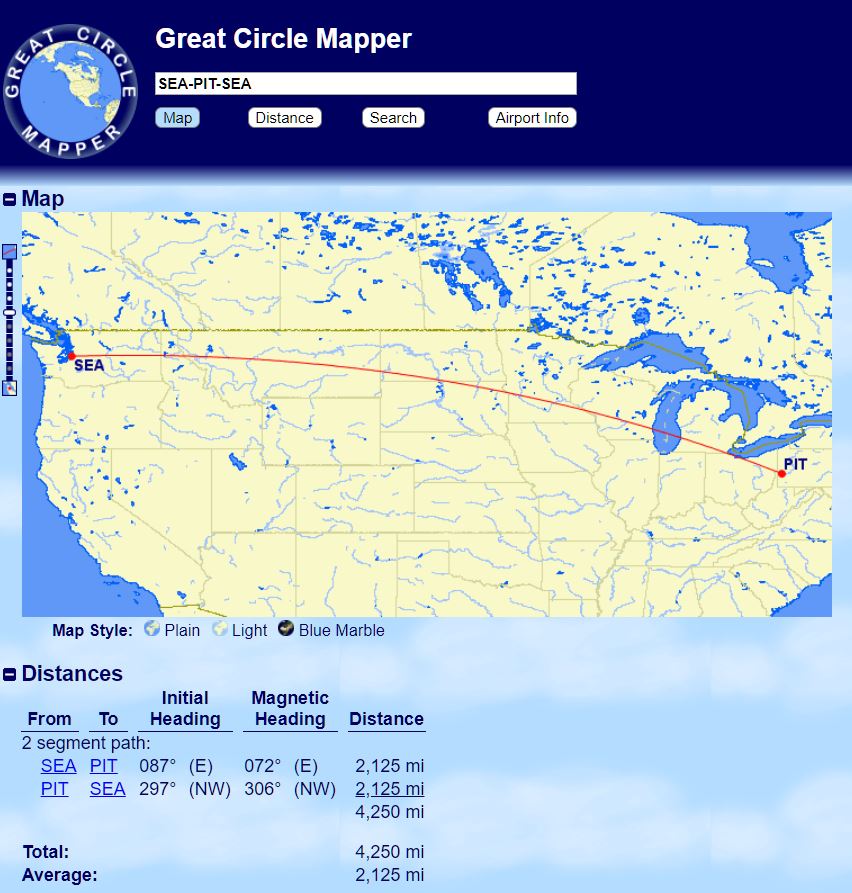
In order to identify your CPM, first you have to know how to figure out how many miles you’re flying. I’m a big fan of the site Great Circle Mapper. Great Circle Mapper has a nice search function where you enter your starting destination-arrival destination-starting destination and it will tell you how many miles you’ve flown on each segment, as well as the total miles.
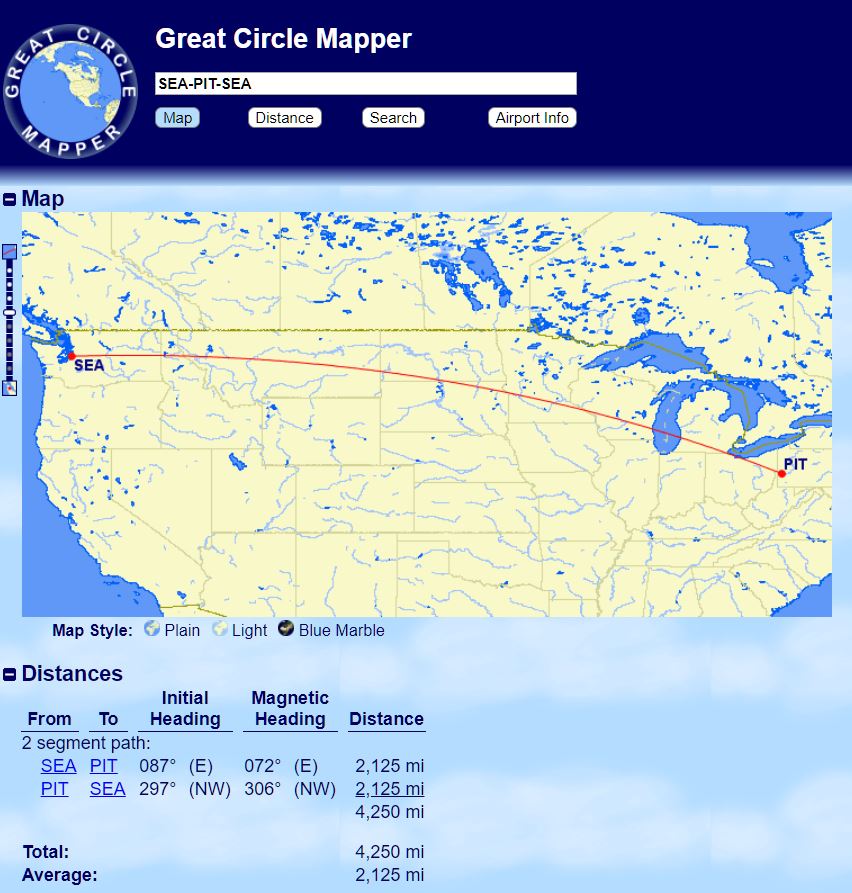
In this instance, I flew 4,250 miles. I had several flight credits that were expiring (coupons for delays or service) that I had to spend or I would lose the money. I used a $300 E-Cert that I’d earned for taking a later flight in 2018. My total out of pocket was $22.50 (E-Certs don’t cover tax). On one hand, you could say my CPM was a ridiculous $.00005 per mile (if only counting what I paid out of pocket). In reality, it was closer to about $.07 per mile. Seven cents per mile is actually a really poor rate as the community generally looks at a mileage run as any fare being less than 5 cents per mile but it was a use it or lose it situation with the certificate.
A few years ago I went to Panama twice on first class mileage runs. Within most programs, you earn additional EQM for flying in First Class (F), Business Class (J), or sometimes in full fare economy (Y). American was running a special to Panama City, Panama in First Class with the catch that you had to make several connections. My first mileage run to Panama was Seattle-Salt Lake City-Houston-Orlando-Miami-Panama City-Miami-Houston-Phoenix-Salt Lake City-Seattle. I think I earned around 20k elite qualifying miles that weekend, I got to see the Panama Canal, and eat the best ceviche in the world. A couple months later I did another run to Panama City that was more benign: Seattle-Los Angeles-NYC-Miami-Panama City-Miami-NYC-LAX-Seattle. I also had 2 work trips that week.
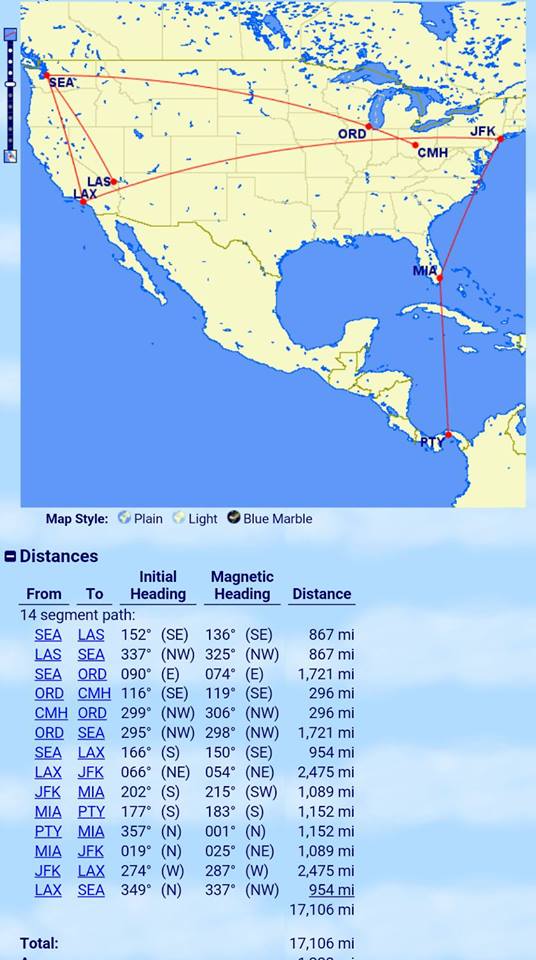
With bonuses, I easily earned 30k BIS miles and 50k redeemable miles.
Where do I Find These Fares?
Sometimes, you just luck out into a good fare by dumb luck. More often than not, you have to be looking. Social media is your friend. On Facebook, I follow several fare sites and mark them to show at the top of my feed: YVR Deals (deals out of Vancouver’s airport), Alaska Airlines, Hainan Airlines, and Secret Flying. I do follow some blogs on Twitter but I usually read them on Feedly. On Twitter, I follow @theflightdeal and have push notifications enabled (this is how I got my Panama fares).
Once you find a fare you’re interested in, make sure you know what fare bucket it books into and double check the mileage you earn on your airline. Some fares, like basic economy or saver fares will earn less whereas first or business fares will earn more.
Also, when booking, make sure you maximize your purchase with the right credit card. If the fare seems too good to be true, book it through one of the big travel sites like Orbitz or Expedia as they are more likely to honor a mistake fare.
Questions?
What did I leave out or what is unclear?
 The Travels & Tips of Nurse Traveler